If the room can’t hear you, nothing else you do matters: not your script, not your jokes, not your lovely introductions. Most of the sound problems I see at weddings come down to a handful of simple habits, and anyone can learn them in five minutes.
The microphone you’ll probably get
At most weddings you’ll be handed a wireless handheld microphone. Most of these are dynamic, cardioid microphones, and those two words tell you two useful things.
Dynamic microphones are fairly insensitive, which is why they need to be close to your mouth. Hold it down at your chest and you’ll sound thin and quiet, the sound person will turn you up to compensate, and that leads straight to feedback.
Cardioid means it hears what’s in front of it and largely ignores what’s behind it. The front is the end with the round mesh grille. Point the grille at your mouth, and keep the back of the microphone pointing towards the speakers.
How to hold it
Hold it around the middle of the handle, and never by the grille. Bring it up so the grille sits just below your chin, about two fingers’ width from your lips, angled slightly up towards your mouth, as though you’re about to take a bite of an ice cream.
Then keep it there. The most common mistake by a mile is turning your head to look at the couple and leaving the microphone behind. When you turn your head, turn your hand with it, as though your hand and your chin are tied together with a short piece of string.
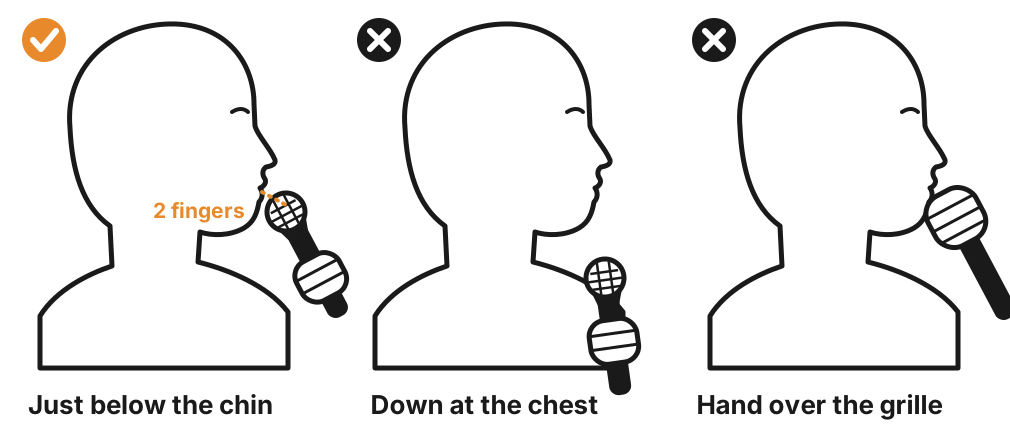
- Don’t cup the grille. Your voice goes muffled, and it’s one of the fastest ways to cause feedback.
- Don’t tap it or blow into it. Just say “Evening, everyone” at a normal volume and you’ll hear straight away whether it’s on.
- Don’t gesture with your microphone hand. If you talk with your hands, use the other one.
- Hold your notes in the other hand, and don’t let them cover the microphone.
Don’t shout
With a microphone you don’t need to project. Speak at the volume you’d use across a dinner table and let the sound system do the work. Shouting into a microphone sounds harsh, and the sound person will just turn you down. What you do need is to speak clearly and a little slower than normal, because sound bounces around a big room and every word needs time to land.
The Wedding MC Handbook has the rest: word-for-word scripts for every part of the night, three full run sheets, every template, and seventeen chapters on doing it well, from someone who has done it hundreds of times.
Get the book for A$39How to stop feedback
Feedback is that squeal you’ve heard at every school assembly. It happens when sound from a speaker gets picked up by the microphone, comes back out louder, and keeps looping until it howls.
You can prevent almost all of it by staying behind the speakers, the big boxes on stands at the front of the room or either side of the dance floor. Stand behind the line of the speakers, face the room, and the back of your microphone points at them, which is the direction it mostly ignores. Most feedback happens when someone wanders out onto the dance floor, in front of the speakers, to get closer to the couple.
If it does squeal, don’t cover the microphone with your hand. Step back behind the speakers and point the microphone down and away from them.
Wireless microphones
Nearly every wireless problem comes down to three things.
Batteries. Most wireless handhelds take two AA batteries, and they go flat at the worst moment. Ask whether they’re fresh, and bring a pack of your own if you want to be sure.
The switch. Find the on, off or mute switch during your sound check, so you can mute yourself between announcements. You don’t want to give the room a live broadcast from the bathroom.
Range. Stay in the room, and roughly in sight of the receiver, which is usually on the DJ’s desk.
Coach your speakers
Everything here applies to your speakers too, and they won’t know any of it. Before they go on, put the microphone in their hand at the right height, show them where two fingers from their lips is, and tell them to turn their hand when they turn their head. It takes thirty seconds and it’s often the difference between a speech the whole room hears and one only the front tables hear.
Get the free starter kit. The welcome script word for word, a sample run sheet and the speaker briefing, by email.